Habits
How to find an accountability partner for healthy habits

The easiest accountability partner to find is someone you already talk to most days: a sibling, a close friend, your partner, a colleague who walks at lunch. What makes it work is agreeing on specific goals, seeing each other’s progress without having to report it, and keeping check-ins kind.
An accountability partner does not need the same goals as you. They need to be reliable, interested in how you are doing, and happy for you to be interested back.
Steps at a glance
- Pick someone you talk to anyway. Choose a friend or family member you are in touch with most days and trust to be kind.
- Agree on one or two specific goals each. Name numbers and times, like 8,000 steps a day or in bed by 11 on weeknights.
- Make progress visible. Use a shared place where progress shows up on its own, so neither of you has to post updates.
- Decide how you will nudge. Agree on what a helpful nudge looks like and when it is welcome.
- Review together once a week. Spend five minutes on what went well, what got in the way, and whether a goal needs adjusting.
Who makes a good accountability partner
You do not need someone as motivated as you. Look for these instead:
- Reliability. They reply, they show up, and they remember what you said you would try.
- Warmth. They celebrate a good day and shrug off a bad one with you.
- Regular contact. Accountability fades when you only talk once a month.
Agree on specific, visible goals
Vague goals produce vague accountability. “Sleep better” is hard to support; “in bed by 11 on weeknights” is easy to notice and easy to cheer. Good examples are 8,000 steps a day, 10 mindful minutes, or checking in every evening.
Keep it to one or two goals each at first. When they feel automatic, add another.
Nudge, don’t nag
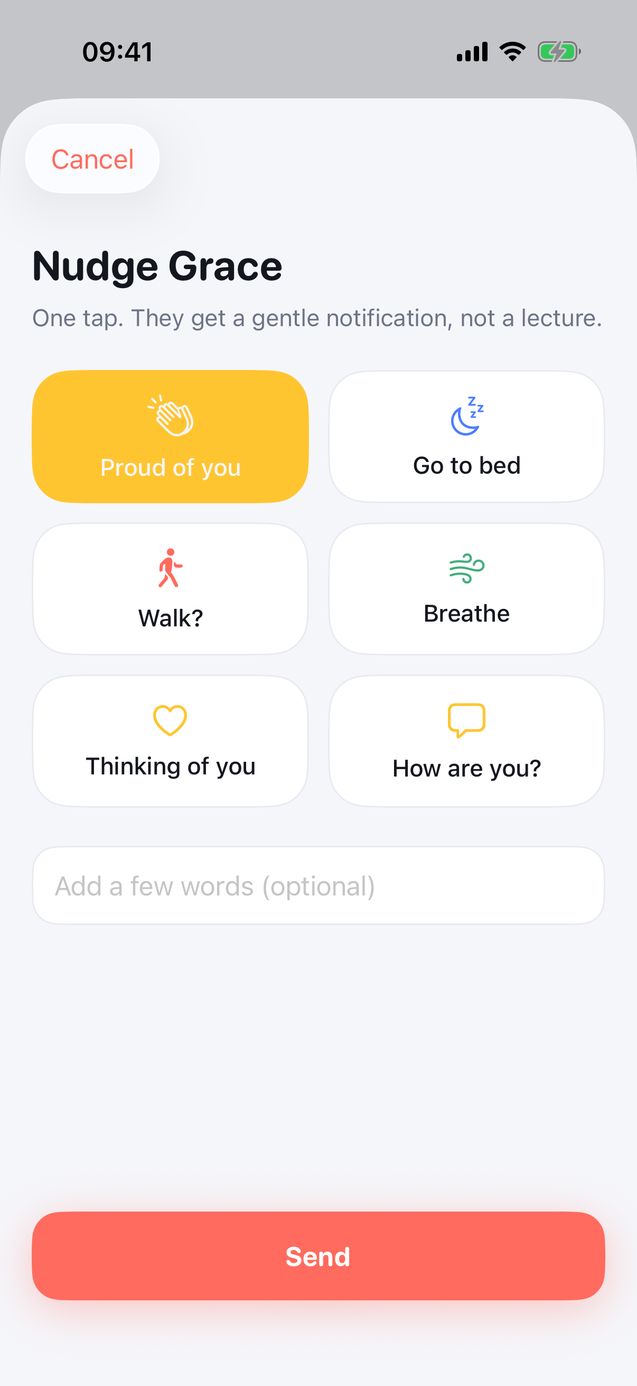
A nudge is an invitation: “Walk?” at lunchtime, “Go to bed” at 10:45, “Proud of you” after a hard workout. A nag is a verdict. People keep going with the first and quietly stop answering the second.
Agree on words for the days that go badly. “Not yet” is kinder than “missed”, and tomorrow starts fresh either way.
Set up accountability with Wellnest
Start a circle with just the two of you. You each see the other’s rhythm, streak and the parts of the day you chose to share, without sending a single update.
When your partner could use a push, open their card and send a nudge in one tap. Their rhythm resets each morning, so a bad day never follows them around.
What to do when one of you falls off
It will happen. Name it without blame, shrink the goal for a week, and pick one small win to rebuild on. If one of you keeps missing the same goal, the goal is probably wrong, not the person.
Questions
Is it better to have one accountability partner or a group?
One partner is easiest to start with because you both feel responsible. Small groups of three to six add energy and cover for each other’s quiet weeks. Both work if progress is visible and check-ins are kind.
What should accountability partners check in about?
The specific goals you agreed on, plus how the day actually felt. A quick note on sleep, stress or energy explains most missed goals and tells your partner how to help.