Habits
How to track habits with friends

Habit tracking with friends works best in a small group where everyone agrees on what they want more of, and progress shows up in one shared place on its own, so nobody has to post updates. Pick a score that rewards balance across the day. With a single number to beat, the most competitive person wins and everyone else quits.
Done well, tracking with friends turns habits into something you do together, the way a running club turns a lonely run into a Saturday morning plan.
Why tracking habits with friends works
Two things change when friends can see your progress. You are more likely to follow through, because someone would notice. And the effort feels lighter, because you are no longer doing it alone.
The catch is that visibility can turn into pressure. The setup below keeps the first effect and avoids the second.
Pick a score that rewards balance
Single-number leaderboards reward extremes. Twelve thousand steps on four hours of sleep tops a step chart and still leaves you worse off.
A balanced score counts several parts of the day equally, so the way to do well is to touch each one: some movement, enough sleep, a few minutes of calm, and something kind for someone else.
Track habits with friends in Wellnest
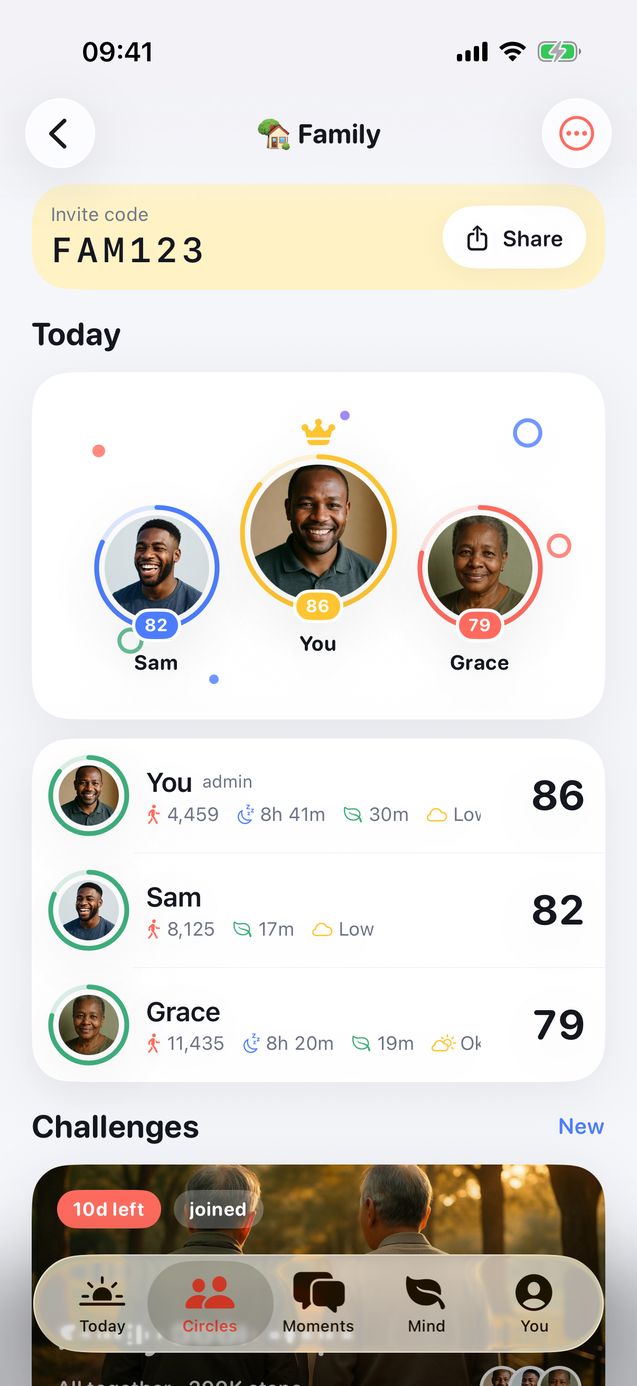
Wellnest gives everyone a daily rhythm score out of 100, split evenly across move, rest, mind, check-in and connect. Steps, workouts, sleep and mindful minutes fill in from Apple Health or Health Connect, and a check-in takes five seconds.
Your circle shows everyone’s rhythm side by side, with a podium for the day’s fullest rings and rows for each person’s steps, sleep and mind minutes. Each person chooses, per circle, whether the others see those details or only the score.
Keep habit tracking friendly over months
Most groups start strong and fade by week three. A few habits prevent that:
- React more than you compare. A heart on a friend’s walk does more than a rank.
- Rotate short challenges every few weeks so there is always something new to aim at.
- Celebrate streaks, and call a broken one “not yet”.
Questions
What habits are easiest to track with friends?
Habits your phone can measure, like steps, workouts and sleep, are easiest because nobody has to log them. Short daily actions, like a check-in or a few minutes of breathing, come next.
How many friends should be in a habit tracking group?
Two to six people works well. Small groups notice when someone goes quiet, and everyone’s progress still fits on one screen.