Family
How to stay connected with family long distance

Families who live far apart stay close by swapping lots of small signals between the big calls: a photo from your walk, a quick “how did you sleep?”, a heart on something that went well. Choose one daily ritual that takes under a minute and one weekly call, and protect both.
Distance rarely breaks a family bond in one go. It wears it down when weeks pass without knowing what the other person’s ordinary days look like. Small signals fill that gap.
Build a daily ritual that takes a minute
A ritual works when it is small enough to survive a busy day. A morning photo of the sky, a voice note on the way home, or a one-line check-in each evening all qualify.
Across time zones, pick a moment that lands in both people’s waking hours. If your parents are eight hours ahead, your morning coffee is their late afternoon, which makes a good slot for a quick exchange.
Use Wellnest as your family’s shared window
Start a family circle and share its six letter invite code. Each person’s rhythm shows up in the circle as the day happens, and each person decides whether that circle also sees their steps and exercise, sleep, mindful minutes and mood check-ins.
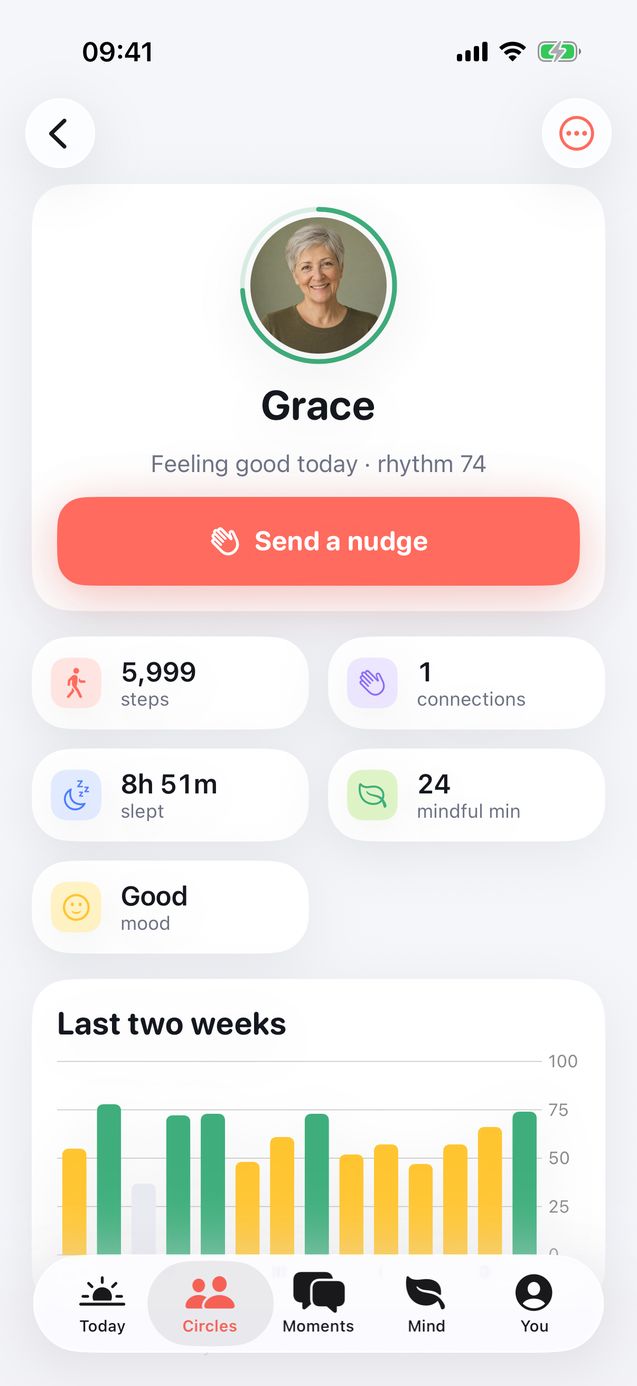
Tap anyone to see their day and their last two weeks. Send a nudge like “Thinking of you” or “How are you?” in one tap, or post a moment with a photo. Each person’s day follows their own time zone.
Keep the big calls, too
Small signals do not replace a real conversation. They make it easier to start one. A few habits help the weekly call:
- Same day, same time. A standing call does not need planning each week.
- Do something together: watch the same show, cook the same recipe, or walk while you talk.
- Ask about something specific you saw during the week, like a long walk or a rough night.
Staying close to aging parents who live far away
With older parents, a daily glance at how they are doing can be reassuring for both sides, and it is much less intrusive than calling to ask. Agree on what they are comfortable sharing, and let them choose.
Wellnest is not a safety or emergency alert service. If you need to know that a parent living alone is okay every single day, a dedicated check-in service with missed check-in alerts is the right tool, alongside the everyday closeness Wellnest offers.
Questions
How often should you contact family who live far away?
There is no right number. Many families settle on a small daily signal, like a photo or a check-in, plus one longer call a week. What matters most is that the rhythm is easy enough to keep.
How can I stay close to family in a different time zone?
Find the overlap in your waking hours and put your daily ritual there. Use messages and nudges that do not need a reply straight away, and save live calls for the times that suit both of you.